Leiko Ikemura – Artforum
4 June 2026
Though Japanese Swiss artist Leiko Ikemura has no children of her own, she embraces an idea of “motherness” as a transformative, nonbinary metaphor for artistic creation. This exhibition, “Motherscape,” presented paintings, drawings, sculpture, and an animated film in an expansive, collaborative terrain crafted in partnership with color-rich and undulating scenography designed by the artist’s architect husband, Philipp von Matt. Throughout, Ikemura’s poems appeared in vinyl wall text in German and English, sketching a fertile interdisciplinary landscape: “Motherscape / all living beings / create themselves . . .” In the mirror-lined corridor leading to the main galleries, once a central artery of the Habsburgs’ largest imperial residence, a menagerie of Ikemura’s hybrid creatures in patinated bronze and glazed terra-cotta perched on tall white plinths.
Embryonic in their amorphic ambiguity, several of the simple sentinel-like sculptural figures in terra-cotta or bronze that lined this passage sprout lagomorph ears. The glazed terra-cotta Gelber Hase (Yellow Hare), 1994, for example, playfully echoes Albrecht Dürer’s iconic watercolor, Young Hare, 1502, one of the stars of the Albertina’s collection, but the hare’s tall auricles rise from what looks like a girl’s pale torso. It’s not the only one of Ikemura’s sculptures to bear feminine markers. A long dress, for instance, as in Lyly, 2013/2023, is paired with a jaunty hand posed on a hip. The golden face of the blue-frocked Schwarzer Miko in blauem Rock (Black Miko in a Blue Skirt), 1995, resembles a horse’s more than a high priestess’s. Ikemura’s fluid movement between her work in the foundry, the kiln, and on paper and canvas blurs the visible distinction between unique media. In Ikemura’s hands, fired earth starts to resemble polished metal, and patinated alloy can look like glazed clay.
In the central gallery, the bronze sculpture Gelbe Figur mit drei Armen (Yellow Figure with Three Arms), 1996–2019, with its tentacular appendages pressed over its eyes and mouth, faced three paintings of girls. Difficult Girl, 2022, and Untitled, 2025, both in tempera and oil on jute, and Girl in Dark Brown, 2022, in tempera and oil on coarse cotton, each depict a hazy, nearly transparent childlike subject in white, turquoise, and rich ocher, respectively. Loosely haloed in foggy auras of more luminous pinks and yellows, these figures fracture the frontier between individual and environment. The painter’s loose and diluted strokes fragment on contact with the thick weave of these coarse supports. The disintegration of gesture and form is contained within the very process of their making.
As an art student in Spain in the 1970s, Ikemura developed a love for Goya. While Ikemura’s works on paper, such as the double-googly-eyed cartoon-faced Untitled, 1992, are decidedly more humorous than most of his, the repetition of naked figures, human and animal, rubbed raw with smudges of crimson and peach, echo the Spanish painter’s fearless gaze.
Ikemura’s tall bronze sculpture Usagi Kannon Janus (340), 2012/2025, reigned over the darkened lower-level gallery. Here as elsewhere, the imagery in Ikemura’s sculpture seems to emerge from her painting, the art for which she is best known. Standing some eleven feet tall, the rabbit-eared human form calmly holds its hands in prayer above a long gown opened with a child-size doorway and pierced by hundreds of tiny holes, like a blanket of stars. Ikemura made this work following the Fukushima disaster. It was illuminated here by five electric-lit glass sculptures (Cat, 2020–23; Kitsune, 2022; Lying Luz, 2020–23; Usagi with wings, 2022; and With Hummingbird, 2022) and the artist’s painted film Carpe Diem, 2025. This layered, digitized, and wall-projected image slowly scrolls downward, as if a viscous drop of paint. Reveling in the generative possibility of new media while pushing her own work to the scale of public sculpture and into the territory of design, Ikemura’s work in the motherscape radiates beyond the limits of the museum.
Read the full article by Lillian Davies for Artforum here.
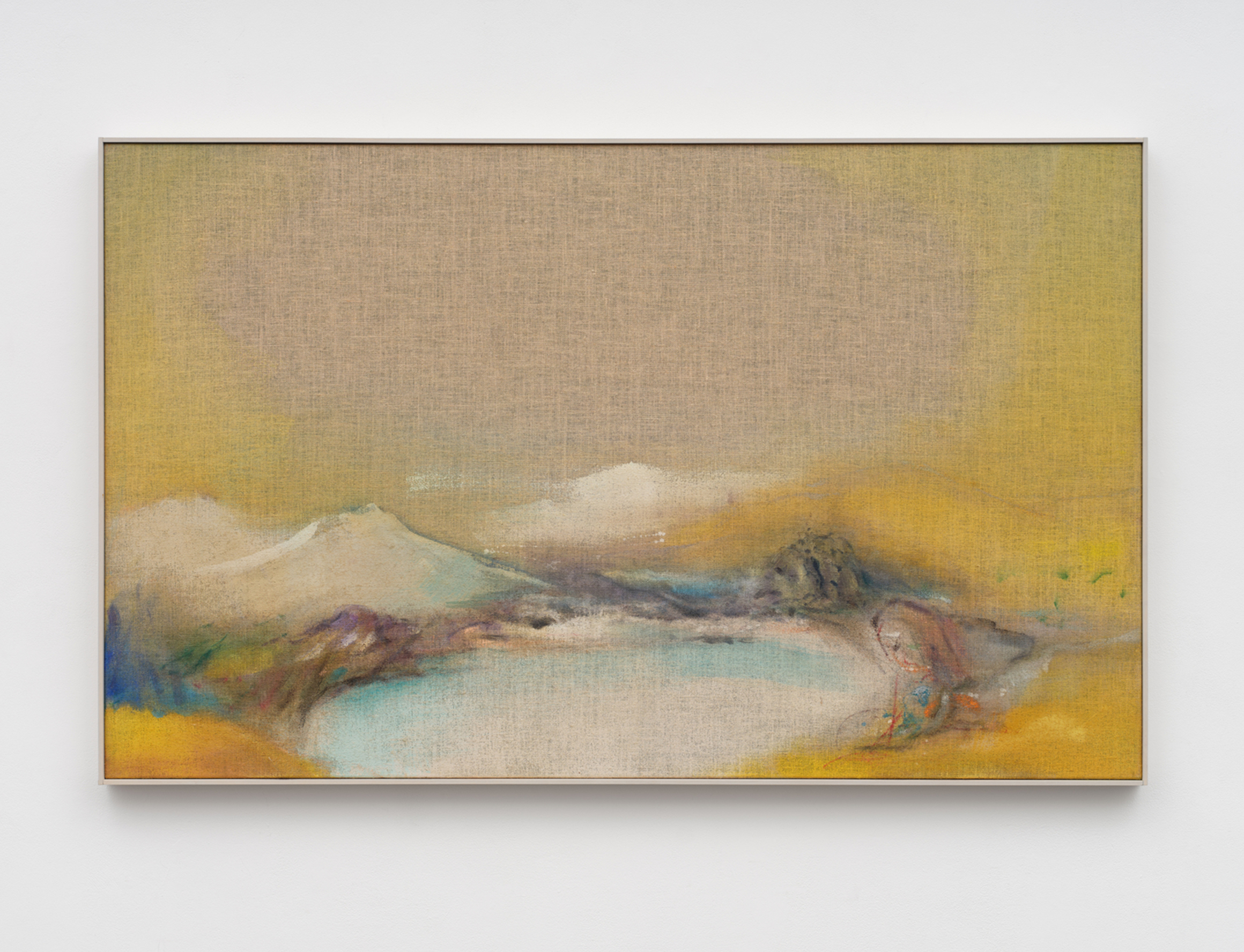
Image: Leiko Ikemura, Yellowscape, 2020, Tempera and oil on jute, 110 x 180 x 4 cm, 43 ¼ x 70 ⅞ x 1 ⅝ in © Leiko Ikemura, Courtesy Lisson Gallery